July 2026 independent community research
San Antonio Housing Access Report From housing supply to housing access
This public edition examines whether San Antonio residents can realistically apply for apartments and rental communities—and whether screening, fees, voucher policies, and navigation systems help or block the path to stable housing.
Community research collaboration
American GI Forum of My City Is My Home developed this community research with contributions from UTSA Rowdy Corps Community Scholars through the UTSA Center for Civic and Community-Engaged Leadership.


What the 2026 baseline found
Available does not always mean accessible.
This public edition keeps Housing Finder apartment research, direct HUD-VASH telephone outreach, and Housing Helper testing separate so each finding can be read according to its own source and method.
Housing Finder properties
Apartment, mobile-home, and related rental-community records reviewed.
Apartment Section 8 “No”
787 of 1,128 clear analytical classifications; 100 unclear records excluded.
Properties called about HUD-VASH
A separate telephone survey of apartment and multifamily properties.
Reported not accepting HUD-VASH
Responses recorded when the properties were contacted during the research period.
The report’s framework
Housing success requires three connected systems.
Counting units is only the first step. Residents must also be able to access and navigate them.
1. Supply
Does a potentially suitable rental exist for the household?
2. Access
Will the household receive a realistic opportunity to apply for and rent it?
3. Navigation
Can the household complete screening, payments, inspections, referrals, and deadlines?
Independent research sources
See how the public findings were developed.
The apartment records, direct telephone survey, and Housing Helper testing are separate research streams. They are not combined into one citywide percentage.
Need the research team’s help?
Ask about the apartment data, direct outreach, definitions, or methodology.
Community accountability
Track the five policy recommendations.
The July 2026 baseline makes it possible to track whether each action is introduced, adopted, funded, implemented, rejected, or left without action.
Remove the five-unit threshold from veteran source-of-income protection
Next checkpoint: San Antonio’s scheduled review of the veteran ordinance.
Adopt Know Before You Pay and portable-application safeguards
Priority for City-supported and participating housing beginning in FY2027.
Establish fair-chance and alternative-identification standards
Focus: rental housing receiving City funding, incentives, land, or other support.
Develop a phased rental registry and public-data system
Phase 1 would focus on professionally managed rentals and useful public information.
Add targeted rental-access priorities to the State Legislative Program
Prepare the City’s priorities for the 90th Texas Legislature while protecting veteran authority.
Accountability timeline
From policy adoption to measurable results.
Veteran protection took effect
San Antonio’s veteran source-of-income ordinance became effective.
Community baseline released
The report established findings and policy benchmarks for future comparison.
Ordinance review checkpoint
Track the five-unit threshold, enforcement, reporting, and implementation.
Transparency and limitations
Read the findings accurately.
This public edition uses three independent research streams. Their totals should not be combined into one unsupported citywide percentage.
Apartment research
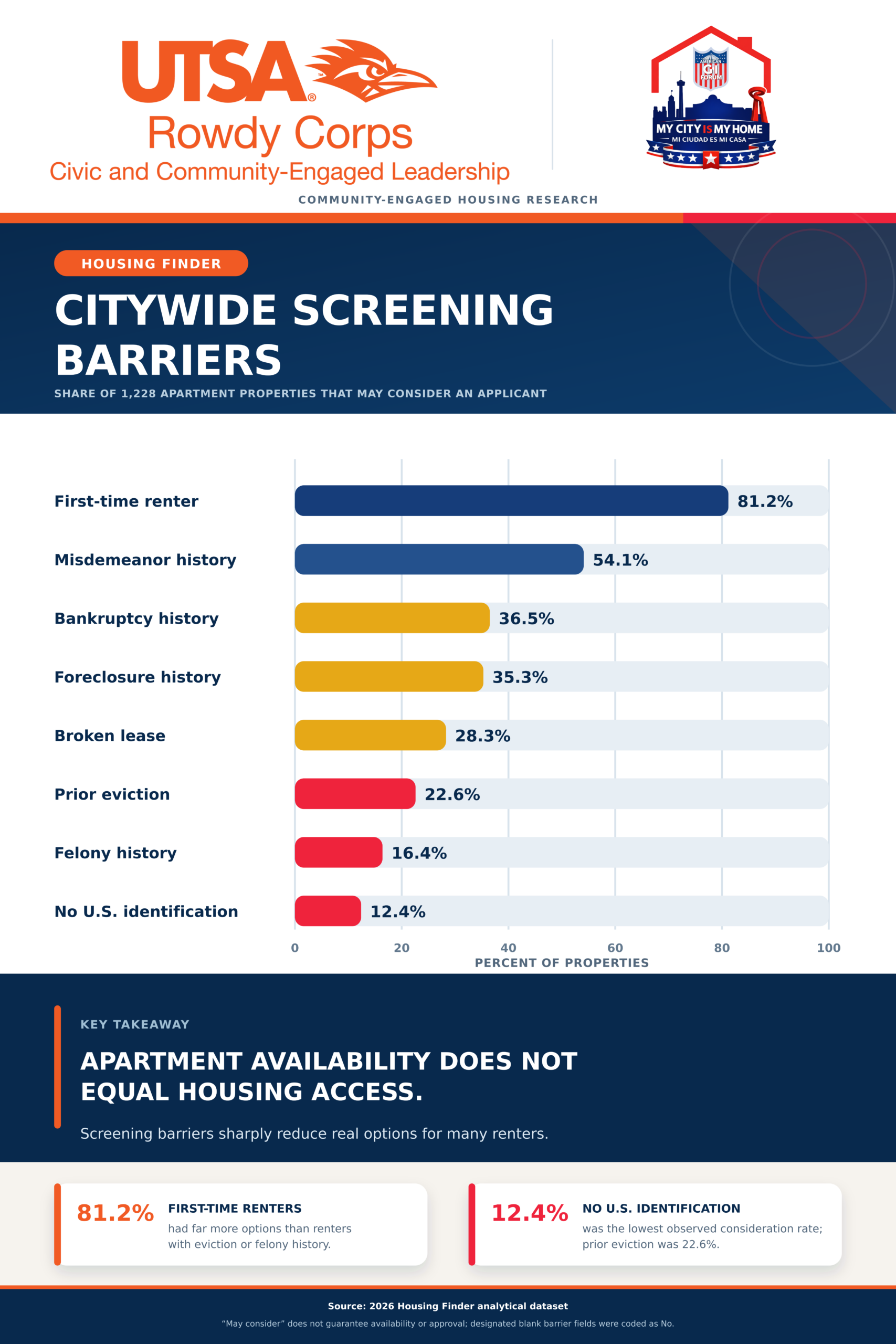
The Housing Finder analysis contains 1,228 rental-community records. Under its analytical rule, a blank Section 8 field is classified as “No,” while a later clear verification overrides the earlier entry.
- 787 Section 8 No
- 341 Section 8 Yes
- 100 income-based or otherwise unclear
Direct HUD-VASH outreach
Volunteers separately called 105 apartment or multifamily properties and recorded the response given when they asked about HUD-VASH. A telephone response is a time-specific research observation and may later change.
- 105 properties contacted
- 93 reported not accepting HUD-VASH
- Results are not a list of confirmed legal violations
Housing Helper testing
Housing Helper testing examined whether residents could turn common housing questions into short, practical next steps and connections to relevant San Antonio resources.
- Navigation findings are reported separately from property research
- The tool is not a legal service or case-management system
- Residents should verify time-sensitive information with the provider
The public page does not identify individual properties from the direct outreach. Research records are maintained for correction, legitimate research, policymaking, and appropriate review. They are observations from the research period—not a list of confirmed ordinance violations.
Apartment district comparisons are not presented in this public edition because the working assignments use ZIP-overlap and nearest-district-centroid rules rather than complete address-level geocoding. Contact the research team for questions about definitions, limitations, or methodology.
Use the baseline to move housing policy forward.
Explore the Housing Finder, use the Housing Helper, or contact the research team about the independently collected apartment and outreach findings.